The Cornet King: Herbert L. Clarke Restored on Compact Disc
Own A Piece of Trumpet History...
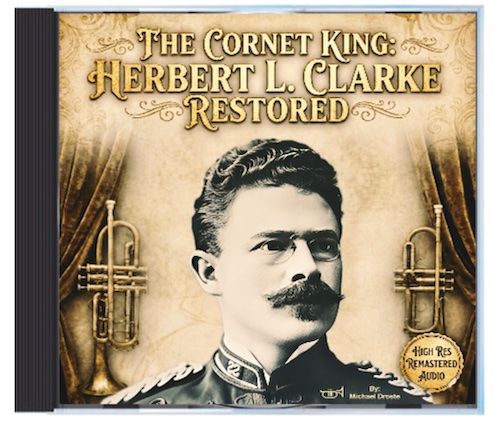
The Cornet King: Herbert L. Clarke Restored is not merely a historical reissue. It is a recalibration of how we hear one of the most important brass musicians who ever lived. In this TrumpetStudio.com release, Michael Droste treats Herbert L. Clarke’s recordings not as fragile antiques, but as living documents—performances meant to instruct, inspire, and occasionally intimidate. What emerges is not a dusty monument, but a vibrant, breathing musician whose influence still hums beneath modern trumpet playing like a buried power line.
Herbert Lincoln Clarke was born in 1867, long before “high fidelity” meant anything beyond personal integrity. By the time these recordings were made—largely between 1903 and 1912—Clarke had already shaped American cornet playing through his work with the Sousa Band, his compositions, and his now-canonical technical studies. These recordings were created in the acoustic era, where sound was physically carved into wax by air pressure alone. No microphones. No edits. No second takes worth mentioning. Every phrase here is a tightrope walk over silence. That matters, because it explains the extraordinary discipline you hear in every bar.
The opening Carnival of Venice (2:44) still functions as a rite of passage for brass players, but hearing Clarke himself perform it resets expectations. The variations are not rushed. The articulation is compact and buoyant, never aggressive. Fast passages sparkle because they are rhythmically aligned, not because they are forced. This is virtuosity as inevitability, not exhibitionism. The same philosophy governs Caprice Brilliante (3:35) and Rondo Caprice (From the Shores of the Mighty Pacific) (2:23). Clarke’s technique dissolves into the music; you notice the character before the difficulty.
Several lyrical selections—Bride of the Waves (3:16), Berceuse from Jocelyn (2:54), Macushla (3:02), and Killarney (3:19)—reveal something modern players often overlook: Clarke’s restraint. His vibrato is narrow and purposeful. His phrasing breathes like a singer trained on text, even when the melody floats free of words. In The Palms (3:30) and Aloha Oe (3:08), sentiment never curdles into syrup. Clarke trusts the melody. That trust is the mark of a mature artist.
The march recordings conducted by Clarke—Washington Post, Liberty Bell, El Capitan, Semper Fi, and Tannhäuser—are among the most historically valuable tracks here. These are not just performances; they are tempo documents. Modern march interpretations often drift toward heaviness or theatricality. Clarke’s tempos are alive, buoyant, and precise. Inner voices speak. Accents lift rather than crush. The band sounds unified because phrasing is shared, not imposed. You hear why Sousa relied on Clarke not only as a soloist, but as a musical authority.
Russian Fantasie (2:48) and Jack Tar (2:15) offer lighter character pieces, brimming with rhythmic wit and stylistic clarity. Clarke never caricatures national styles; instead, he suggests them with articulation and color. That economy is instructive. In an age of excess, Clarke reminds us how much can be said with very little.
One of the crown jewels of the collection is Rhapsodie Hongroise No. 2 in C-sharp minor (4:06). Liszt’s piano original is a monster of bravura and rubato, yet Clarke adapts it seamlessly to cornet. The rhythmic control is astonishing. The accelerandi feel organic, never panicked. Ornamentation is fearless but clean. This performance demolishes the idea that early brass players were limited by their instruments. Clarke is limited only by taste—and his taste is formidable.
The ensemble pieces, including American Brass Quartet (2:31) and Southern Cross (3:02), highlight another dimension of Clarke’s musicianship: balance. He listens. He blends. Even when leading, he does not dominate. This collaborative instinct is part of why his legacy endured not just through recordings, but through generations of students.
What elevates this release beyond historical curiosity is Droste’s restoration work. Noise reduction is applied with surgical restraint. Attacks remain crisp. The cornet’s edge—the slight bite that defines Clarke’s sound—is preserved. The goal is not to make these recordings sound “modern,” but to make them intelligible on modern systems without falsifying their character. In that, the project succeeds. The listener hears past the medium and into the musician.
For students, this album is a masterclass in articulation, phrasing, tempo, and musical priorities. For professionals, it is a reminder that efficiency beats force and clarity outlasts volume. For historians, it is evidence—clear, undeniable evidence—of how sophisticated American brass playing already was at the dawn of the recording age.
Clarke once wrote that “the average cornet player does not fail from lack of ability, but from lack of patience.” Listening to The Cornet King: Herbert L. Clarke Restored, patience becomes audible. Every note has waited its turn for more than a century. Thanks to this restoration, those notes finally speak again—confident, elegant, and unmistakably alive.
Image from Herbert L. Clarke Papers, 1880-1945 (series 12/9/54), Sousa Archives and Center for American Music, University of Illinois at Urbana-Champaign

